Plan labelling and short answer · 6 questions
Finding your way around the learning centre
1. Read the questions, then listen
Original script · synthetic voicesA staff member gives new visitors an original orientation to a fictional community learning centre. This is a short skill exercise, not a full IELTS test. You can pause, replay and change speed while learning.
2. Answer 6 questions
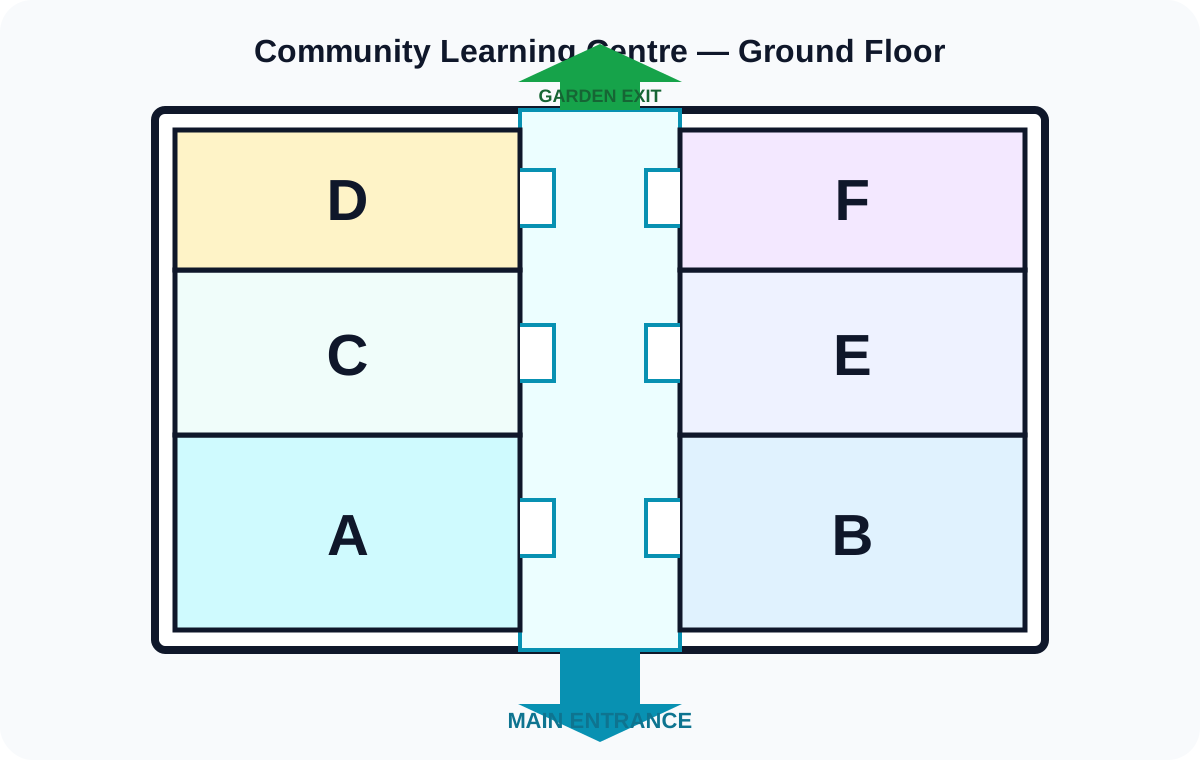
Study the plan, then choose the correct letter A–F for Questions 1–5. Complete Question 6. Write NO MORE THAN TWO WORDS AND/OR A NUMBER.
Transcript support
For a listening-only first attempt, check your answers before opening this. It contains the answers. Opening it before checking labels the attempt as transcript-supported.
Answers and results are not saved to your account or sent for AI processing. Download your review before leaving or refreshing. Scores use this exercise’s answer key, not an IELTS band conversion. Audio uses prepared computer-generated voices and does not represent the full range of exam accents or delivery.
About this section
A staff member gives new visitors an original orientation to a fictional community learning centre. It has 6 questions in the format: plan labelling and short answer. The recording is an original script read by a synthetic voice, so you can pause and replay it. That makes this a study aid, not the official test experience.
Plan labelling tests whether you can follow directions. Find your starting point on the plan, then listen for words such as opposite, next to, beyond and on the left as the speaker moves around.
After you check your answers you get a raw mark, the evidence for each answer in the transcript and an explanation. A raw mark is not an IELTS band estimate; see how Listening marks relate to bands.